
According to currency dealers, any sharp movement in the rupee might result in the Reserve Bank of India intervening in the foreign exchange market.

The price difference between branded tea and loose tea has narrowed to a mere 5 per cent, helping the consumer to opt for branded labels. According to Bloomberg, the wholesale price index for tea in India gained 74 basis points from 128.30 in January to 222.50 at end of October this year. As a consequence, tea manufacturers in the wholesale and loose tea business, besides branded tea players, have increased prices.

"The main risk stems from the uncertainty surrounding the outcome of the south west monsoon in view of the rising probability of an El Nio event around July-August, and its implications for food inflation," RBI said, as it kept the status quo on key interest rate for the third time in a row.

Rajan has been facing continuous attacks by Bharatiya Janata Party MP Subramanian Swamy and some other sections, who have alleged that he has failed to lower interest rates and boost the economy

The government is scheduled to release index of industrial growth for November and consumer price inflation for December later today.

Jio Financial Services, the demerged financial services unit of Reliance Industries, will be listed on bourses on August 21, according to an exchange notification. Jio Financial Services Ltd (JFSL) demerged from Reliance last month and is currently listed under a dummy ticker after its price discovery at Rs 261.85 but there is no trading happening in the scrip. The listing on BSE and NSE has been scheduled a day before FTSE Russell plans to drop JFSL from its indices.

Commodity investments can help you diversify your portfolio in asset classes other than equity and debt, says Dwaipayan Bose.
Some say the MPC will raise the rate, while others are of the view that there is already de facto interest rate tightening through rising bond yields, which might prompt the central bank to go for a pause.

The rate of price rise of food items stood at 12.68 per cent in the corresponding week of the previous year.

India's annual industrial output grew at a slower-than-expected pace of 3.6 percent in September.

The report, however, said it remains watchful of the upside risks to inflation emanating from pass-through of minimum support prices (MSPs), adverse movement in crude oil prices, volatility in global financial markets, lagged impact of the rupee weakness on input prices, adverse implications from fiscal slippage and staggered impact of HRA increases by states and its second-round impact.
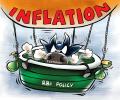
Inflation breached the upper end of the RBI's comfort level of 4 per cent plus-minus two percentage points.

Decisions should not be based on feelings, such as optimism or pessimism about the stock market or specific investment products, suggests Avinash Luthria.
The Reserve Bank is likely to maintain status quo on interest rates in its forthcoming monetary policy review but may change the stance in view of retail inflation piercing its upper tolerance limit, global uncertainties created by the ongoing Russia-Ukraine war, and the urgency to protect and boost growth, feel experts. The RBI governor-headed rate setting panel -- Monetary Policy Committee (MPC) -- will be holding its first meeting of the 2022-23 fiscal from April 6 to 8. The outcome will be announced on April 8.

The country saw two straight years of deficient monsoons.

DBS called Rajan's decision not to seek an extension as a 'negative surprise'.

Forex dealers said besides the dollar's gain against other currencies, fresh demand for the American unit from importers and a weak opening in the domestic equity market put pressure on the rupee.
Banks and Capital Goods scrips among the top losers in noon deals.

Rediff.com takes its readers through the various moods of Raghuram Rajan.

The proposed hike is in accordance with the accepted formula based on the recommendations of the 6th Pay Commission

Global markets trends, inflation, release of industrial output data and quarterly earnings will dictate movement of the equity benchmarks this week, analysts said, adding that volatility might continue amid slew of announcements of macroeconomic data at the global level too. Moreover, foreign fund movement, crude oil prices and trend in rupee would also act as major drivers for the equity market, they added. "The direction of global equity markets along with movement in dollar index and crude oil prices will continue to dominate while inflation numbers of the USA on May 11 and inflation and IIP numbers of India on May 12 will also cause volatility in the market," said Santosh Meena, head of research, Swastika Investmart Ltd.

On the reduction in the SLR ratio, he said it was a signal from the point of view of long-term reforms.
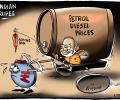
Retail inflation inches up to 3.77%; IIP growth dips to 3-month low
.jpg)
We invite our readers to share their thoughts on water conservation with us on our social networking platform, ZaraBol -- Click #How-to-Conserve-Water to post

Many analysts argue with limited space for a fiscal stimulus, the burden of lifting growth lies squarely on monetary policy.

Onions had the highest inflation rate among all major commodities.

The Sensex ended 229 points down at 27,602 and the Nifty ended down 63 points at 8,293.
Although the WPI-based inflation has been in the negative for two consecutive weeks, the Consumer Price Index, which measures movement in the prices that consumers pay, reported double-digit increase in May.
D-Street is hoping RBI policy review meeting on Tuesday will uphold its stand on easing of interest rates
The breadth, indicating the overall health of the market, was slightly positive

'Business families like the Godrej group are increasingly realising that an amicable settlement is better.' 'Else, the wealth of all shareholders gets destroyed.'

The rate of price rise in food items stood at 17.14 per cent in the corresponding week of 2010.

In the context of RBI's view that the real interest rate, defined as the repo rate less "look forward" CPI, should be around 150-200 basis points.

The central bank, however, warned that the downside risks to growth could play out if global recovery slows.

Prime Minister's Economic Advisory Council (PMEAC) Chairman C Rangarajan may have found the Reserve Bank of India (RBI)'s inflation projections on the higher side, but independent experts agree with the central bank and expect both wholesale and retail prices to remain high.

Key macroeconomic indicators suggest softening industrial growth.

The statement said the food inflation stood at 7.56 per cent in February, 2014, against 8.94 per cent of the previous month and 14.98 per cent during the corresponding month of the previous year.

There is a significant amount of dispersion in the growth rates across different industries.

The benchmark National Stock Exchange Nifty has rallied 4 per cent, or 750 points, from this month's low to end at 19,732 on week ending November 17. Technical analysts say the market could consolidate around the current levels as it is nearing the resistance zone. "The near-term uptrend status of the market remains intact, but there is a possibility of some more consolidation or minor weakness for the Nifty in the next one to two sessions.

There are overvaluation and excesses in many pockets of the market. This is most obvious in the IPO market, where loss-making companies have inflicted large losses on investors, observes Debashis Basu.
 © 2026 Rediff.com - Advertise with us - Disclaimer - Privacy Policy - Sitemap - Feedback - About us - Terms of use - Grievances